Era Ahead

The Scarcity Audit

What stays scarce in your work, and do you own it?

Six questions from the book When Intelligence Gets Cheap. No score, no forecast. Nothing you write leaves this browser.

Or go to the book

The Scarcity Audit

Part 1 — What do you sell?

Use this page for one position: your job as it is today, with your employer, your contract and your clients. The same job title at a different firm can give different answers.

List the three to five outputs that take most of your working time. An output is something someone receives: a report, a reconciled account, a shortlist of candidates, a lesson, a release of software, a client meeting.

1%
2%
3%
4%
5%

Part 2 — The six questions

1. Which output got cheaper, once you count the checking?

Answer for the output that takes most of your time first, then for the others if you have time. Write “don’t know” where you don’t know; that is an answer too, and Part 5 asks what to do about it.

Compare the full cost of a result someone will accept, with and without AI: the tools, the time to prepare and produce it, the time to check and correct it, and the mistakes that get through anyway. Compare time first, person by person, then money. Then ask whether the buyer still wants the same quality, or now accepts less as good enough.

Part 2 — The six questions

2. Did total spending on that output fall or rise?

Does the person who pays for it now spend more, the same or less in total? Does more of that money reach you or your employer, or less?

Part 2 — The six questions

3. What is now the weakest link?

If AI did everything it can do well, which step would still decide the result? Name its form: a step where quality is decided, a step where work queues, or a step that controls access to clients, data or computing power. One step can be more than one.

Part 2 — The six questions

4. Who owns that link?

Answer four questions about that step. The answers often differ; where someone else holds the answer, write who.

Part 2 — The six questions

5. Could a competitor copy it within 24 months?

Could someone with AI and no special access do what you do at that weakest link within two years? What would they need?

Part 2 — The six questions

6. Where does the surplus show up?

When the output got cheaper, who kept the difference: you (time, pay), your employer (margin), your client (price), a tool vendor?

Part 3 — Your switch

Think of someone with the same job title whose answers to questions 4 and 6 would be the opposite of yours. What is different about their position?

Part 4 — Your move

Tick the move your answers point to. Then tick what it requires and what you already have.

Points here if … the step where quality is decided, work queues or access is controlled sits next to you (question 3)

Requires · I have it

Points here if … you can document a gain from your work with AI and ask for an agreed return (questions 4 and 6)

Requires · I have it

Points here if … the money and the decisions are moving somewhere you could reach (question 6)

Requires · I have it

Points here if … you could control client access, a product or a contract, and it is hard to copy (questions 4 and 5)

Requires · I have it

Points here if … nothing at the weakest link is yours or within reach

Requires · I have it

Part 5 — What I don’t know yet

Every “don’t know” in Part 2 is a question to put to someone: your manager, your client, your accountant, your own figures.

For a PDF, choose “Save as PDF” in the print dialog.

Era Ahead

The Scarcity Audit: your worksheet

Appendix A of When Intelligence Gets Cheap, by Era Ahead · eraahead.com

Do it again within twelve months at the latest, and sooner if your contract, your tasks, your team’s budget or the jobs on offer change noticeably.

This worksheet is a decision aid. It does not predict what will happen to your job, and none of the moves comes with a guarantee.

Part 6 — Next time (within twelve months)

Fill in Part 2 again on a fresh copy, without looking at this one. Then compare.

QuestionChanged?What changed
1–6yes no
My switchyes no
My movedone started not started

Part 7 — Once a quarter: the signals (Chapter 12)

One hour, four times a year. Write the value and the month of the data.

SignalWhere to find itStarting valueRethink ifNow
1. Price of a given level of AI performanceEpoch AI, “The plunging price of thought” (epoch.ai)about 13× cheaper a year (report of 22 Sept. 2026)a comparable new estimate below 4× a year
2. Tasks AI finishes 4 times out of 5METR time horizons, version 1.1, 80 % (metr.org/time-horizons)Claude Opus 4.6: about 70 min; early Claude Mythos Preview: about 3 h (models of Feb. and Apr. 2026)a comparable independent estimate of at least 8 h
3. Young workers in AI-exposed jobsStanford Digital Economy Lab, Canaries dashboard: employment index by age group and AI exposure (use the level, not the change)age 22–25, most exposed fifth: 87.2 (Aug. 2026; Nov. 2022 = 100)at least 100 in Aug. 2028
4. US productivity, two-year rateBLS, output per hour, non-farm business (data.bls.gov/timeseries/PRS85006093)about 2.2 % a year (Q2 2024 to Q2 2026)above 2.5 % a year over two years
5a. Rent for an older AI chip (H100)Ornn H100 SXM rental index, daily index history (api.ornnai.com/api/gpu/H100%20SXM/index-history)about $2.75 per chip-hour (average 7 July to 6 Oct. 2026)a later three-month average below $2.06 on the same index
5b. Operating margin of a frontier model makerAnthropic’s financial statements: operating profit divided by revenue, whole company, US GAAP; note whether audited2025, audited: −176 %; first half 2026, unaudited: −4 %; second quarter 2026, unaudited: +8 %a return to operating losses: look for the cause
Your own signals (Chapter 12)What to look atStarting valueRethink ifNow
My toolsprices, limits, retired models, data terms
Who checks and signs at my worknew roles, pay, authority
My auditdate of this sheetdue within 12 months

Record the period the data cover and the date the source was last updated. Save the H100 values when you check them; the free index shows only the last three months. If a source has stopped publishing, write “no comparable update”.

Signal 4, the calculation: divide the latest output-per-hour index by its value eight quarters earlier, take the square root, subtract 1 and multiply by 100. Use revised values from the same release.

Appendix A of When Intelligence Gets Cheap, by Era Ahead · eraahead.com

The worksheet is the last step of the book.

Each question on your sheet names the chapters that work it through. Chapter 11 runs all six questions on five jobs: a client adviser, an accountant, a developer, a recruiter and a teacher.

Available now

Also on Amazon.co.uk and other Amazon stores.

Kept in this browser only.

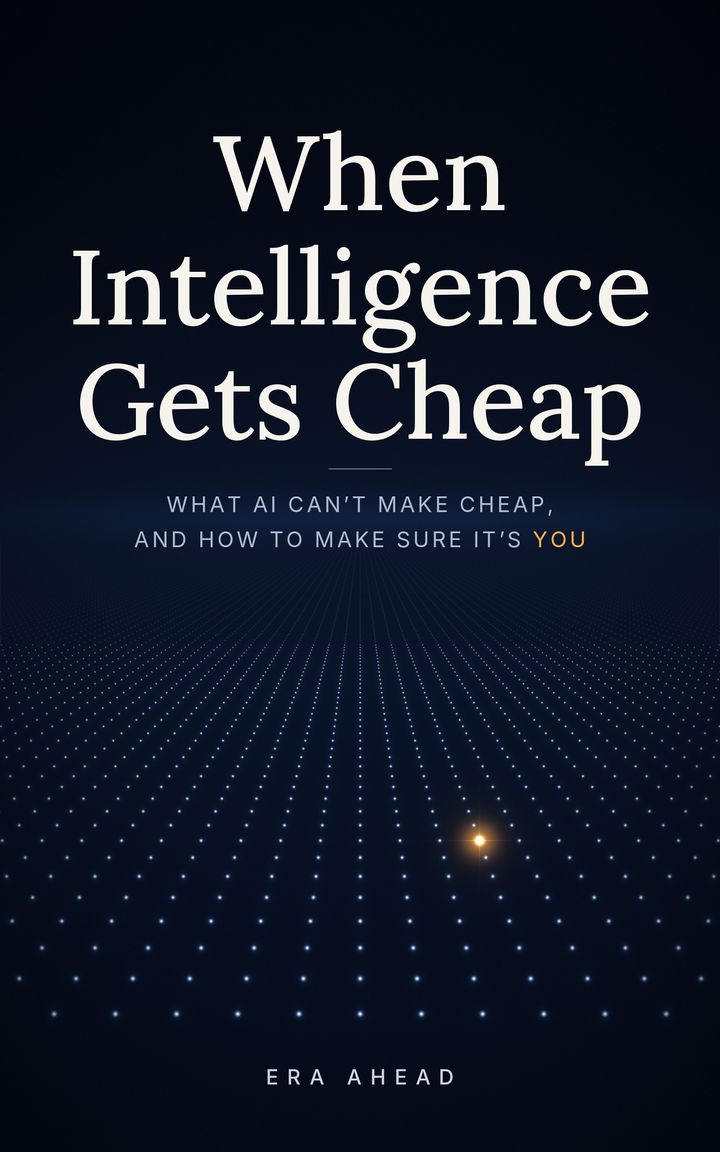
Book cover: When Intelligence Gets Cheap, by Era Ahead

The book

When Intelligence Gets Cheap

What AI can’t make cheap, and how to make sure it’s you

AI can make you more productive. Who gets the reward?

You deliver more in less time. Your employer may expect more. Your clients may expect to pay less. Being better at your job may no longer be enough to strengthen your position.

Drawing on field experiments, labour-market data and company filings, the book separates what is established from what is still uncertain, and sets dated tests for its own predictions.

Available now

Also on Amazon.co.uk and other Amazon stores.

Contents

Every chapter answers one question.

Part I · What Got Cheap

  1. 1The Price of a ThoughtWhat exactly is getting cheaper, and which costs count?
  2. 2Faster, or Does It Just Feel Faster?When does faster work become a more productive workflow?

Part II · What Happens to My Work

  1. 3The Missing First RungHow does anyone become an expert when a machine does the beginner’s work?
  2. 4When Buyers Stop BuyingWhat happens to the price of my work?
  3. 5Who Keeps the Time You Saved?If AI makes my work faster, who ends up with the difference?
  4. 6The Firm Gets SmallerCan I compete alone, or as part of something small?

Part III · What Stays Scarce

  1. 7Someone Has to SignWhat part of my work cannot be copied?
  2. 8The Scarcity MapWhen the work I sell gets cheap to produce, what happens to the money my clients spend on it, and who ends up with it?
  3. 9Do the AI Companies Win?Does the industry that makes AI earn money from it, will its spending pay off, and what does that mean for the tools I depend on?
  4. 10Where the Money GoesOutside the AI industry, who is likely to gain and who to lose, and what does that mean for my money?

Part IV · My Position

  1. 11The Scarcity AuditSo what do I do now?
  2. 12What to WatchHow will I know that things are changing, and that this book was wrong?
  1. 13What Stays ScarceSo what is the answer?

Updates and corrections

First edition, October 2026. No corrections yet. Found an error? Write to hello@eraahead.com. Confirmed corrections and news of the next edition will appear here.